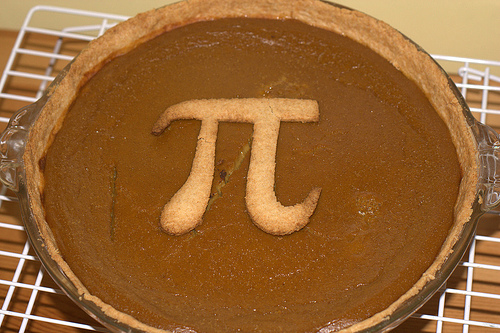
Easy as Pi

Photo CC-licensed from Flickr User Net_Efekt

Yesterday, designer Ellen Gormley asked a great question (via Facebook and Twitter): “crochet/knit designers: What’s your best method for measuring the circumference of a hat?” And when I gave my answer, I thought–“oh, I should share that here on my blog too,” because it’s a calculation I use a lot and you might find it useful too.  Yes, this is math and may require a calculator, but don’t worry because it also involves Pi, and who doesn’t love Pi?

CC-Licensed photo by flickr user pauladamsmith

So, say you have a hat you love, and you want to knit or crochet one that is the same size and shape. How do you figure out the size of the hat? You could measure the circumference (the distance around the hat) with a flexible measuring tape, but this is tricky and probably inaccurate as the fabric and the tape will slide around a lot while you’re doing this. (In fact, if you insist on this method, put the hat on some sort of hard form, like a head, while measuring).

Instead of trying to measure the circumference, I lay the hat flat, so that the whole crown of the hat is visible on a hard surface, and I measure the diameter–the distance across the crown of the head. With that measurement, I can then do a little calculation and find the circumference:

c = πd

C is the circumference, π = (for our purposes) 3.1416, and d = the diameter. So say you measured 7 inches across. Your calculation would be

c = 3.1416 (7) = 21.99 (or 22″)

Then you can take this measurement and, using your gauge swatch (because of course, you swatched right?) You can figure out your foundation chain or your cast on for your hat. (If you’re working from the crown down, you can just crochet until your hat’s diameter matches the size you’re trying to achieve).

New Pattern: Isoceles Shawl

Isoceles Scarf - 15

I made this shawl last fall for the new Tension Magazine and it’s finally been released. This narrow shawl was worked in Filatura di Crosa Superior, a very fuzzy cashmere silk that was lovely to crochet. It’s a filet-crochet style pattern that shifts organically from triangles (hence the isoceles) to diamonds (double triangles) and back to triangles at the end. It’s been a season of shawls. I have had three in the works for most of the winter, and now they’re all finally done and will be released in one form or another over the coming months.

Before I sent off my shawl, I got my friend Erica to model it for me. Here’s another one:

Isoceles Scarf - 31

You can find all of this chilly photoshoot in the slideshow below. Luckily the Orca Books, where we finished up, has hot coffee!

How long is your tail?

DSC_0040

One of my favorite recently learned knitting tips comes from Colleen Borodkin who works at The Net Loft, here in Cordova. When she’s guesstimating how much yarn to spool out for a long-tail cast on, she uses her shoulder width as a guide: 20 stitches per shoulder length. So if you needed 100 stitches, you’d pull off 5 shoulder-widths of yarn. It’s a measuring stick that’s always with you! It works for me too, and works best with worsted weight yarn, bulkier yarn needs more inches per stitch, so add a few extra lengths to compensate.

Of course, if you’re casting on for a giant project you may want to use both ends of your ball instead of a tail—take the two ends and tie them together, then make your slip knot or just a loop. Since you’re pulling from both ends, you’ll never run out or have too much. Just cut the outside edge before you start knitting. That becomes your tail.

This morning I met with my new contract crocheter–she’s a new but very talented crocheter and she worked up one project for me already, and we’re starting on another. I’m so excited to have someone in town to work with, it means I can design a lot more. We have had torrential rain and gale force winds the last few days and everyone is sick of it. The rain has let up at least for the moment, so I’m headed outside!

Olympic Headband for Angela: Crochet Tutorial

Last week, while I was in Friday Harbor, my friend Angela watched my kids for several days–the ship was out and James gone with it. I wanted to make Angela a little something as a thank you, and since she is going to Vancouver in a couple of weeks to watch the olympics, I was inspired by the traditional art of Northwest Coast Indians which often uses black, red and white. (Of course, my crocheted headband is also a nod to the Dale of Norway “Team Norway” sweater which uses the same colors. Were they inspired by the traditional northwest art as well?)

DSC_0046

Here’s the wave chart created using my newly acquired illustrator skills learned in a class at the Visionary retreat. The chart is adapted from a chart in Interweave’s new Harmony Guide to color work patterns.

To make the headband, I made a chain long enough to wrap around my head, then adjusted the stitch count to be a multiple of six–which is the length of the repeat of the chart (above). Be sure your chain is not very tight.

Work the first row of sc into the back bump of the chain. Join to begin working in the round–be careful not to twist your chain (it is hard to see when using black yarn, so take your time.)

The rest of the head band is worked in single crochet through the back loop only. Work one more round in black, then work a round alternating red and black yarn every other stitch. (Remember, when working colorwork, work the last yarn over of the single crochet before changing colors in the NEW color so that the top loop of your new color stitch will be the correct color.)

Here’s a little video I made last year about changing colors in crochet:

Work one round in black after the red/black row, then work the wave chart. After finishing the chart, work two rounds of black, then a final red/black row, and one last round of black. Fasten off and weave in ends. Enjoy!

I do want to particpate in the Knitting Olympics, but I haven’t picked a specific project. I think I will use the event to finish up UFOs and patterns already on my to do list.

I did start cast on for a new hat last night that wasn’t on my list, but it’s something I’ve been thinking about for a while. I’m working it in Malabrigo Merino Chunky in my new Addi Clicks, which for some reason I like even better than the regular Addis. I won’t be watching the opening ceremonies in real time because for some reason on the West Coast they’re not showing them live! But I’ll catch up tonight after I get back from a Copper River Drifters rehearsal. Tomorrow night we’re performing at a Valentine’s dance.

Intangibles

I’ve been thinking a lot about the great discussion of FREE that I mentioned Thursday on the blog. Essentially, its the idea that by giving away information you create a caring community of people who learn about you and what you have to offer as a crafter. It’s a big part of blogging. We give away information, tutorials, tips, etc. I love reading blogs, and I love creating useful posts. I’ve been thinking a lot about how I want my blog to be structured, and I’ve been thinking I’d like to do even more on the tutorial side, too.

One of my other favorite free things to do is interact one-on-one with users of my patterns. Occasionally, but not too often, knitters and crocheters will write me with questions and I enjoy helping them. Often it helps me identify what might be a tricky bit in a pattern, and what might be a concept that I could explain better. So if you would like help or advice on a pattern of mine, please feel free to contact me, via e-mail: (aoh@ipsmedia.com), or ravelry (amyo) or twitter (plainsight). I look forward to hearing from you.

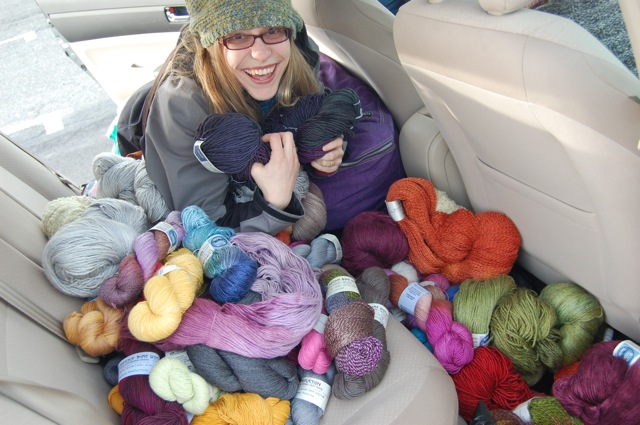
Speaking of free, this is a good bit of the yarn that was sent up by generous Portland yarn dyers for members of Cat Bordhi’s visionary retreat to try out. (Thanks to Leila Wice for taking the picture.) Seeing, touching and working with new yarns is such an important part of the design process. We are all so grateful to the yarn companies who donated the samples.

A Voyage of the Mind


Voyage of Avalon, from Flickr User Reinante El Pintor de Fuego, CC-licensed, some rights reserved

I absolutely love being home. I love setting up house (a good thing since we have to move every 2-3 years) and I love living in a comfortable cozy space and doing the things that create that space. Its ironic then, isn’t it, that one of my favorite things to do is travel?

Last weekend, we went to Anchorage, and we had a great time, and the day after we got back, I was unpacking and repacking, and cursing the fact that I was leaving again the next day for a trip, this time by myself to attend a writer’s workshop. People in town would ask where I’d going and I’d tell them and they’d seem excited and happy for me, but I wasn’t feeling it. I just wanted to be home.

Luckily, I woke up this morning and the travel mojo has caught me again. The BIGGEST reason I love travel is it stimulates my creativity. Being removed from my natural routine and surroundings all of these ideas that I usually need to shove aside because I don’t have time to contemplate them come rushing back. It is a rush. Just this morning, I’ve been having the best time waiting. I’m sitting in the hotel lobby waiting for my ride, and I’ve been reading and interacting with great blogs (Diane of CraftyPod over at Make and Meaning and Kim Werker are stirring things up among crafters with a fabulous conversation on the value of FREE).

I’ve been working for a couple of weeks on a class I’m teaching tomorrow to a group of designers about using social media tools to market your business. I’ve got tons of notes, but this morning, I’ve gotten more great ideas to share than I did in the previous two weeks. I think it’s the travel. As a side benefit, when I travel, I take better care of myself–I don’t eat snacks because they’re not all around me like they are at home (and I don’t miss them). I don’t forget to floss!

Of course, you can harness this great travel mojo when you’re at home. You just have to think and act like you’re on a trip. I know its crazy, but it works for me. When I was writing my Nanowrimo novel and I was stuck, one of the things I could do that was a surefire help was to go for a drive.

Chair lift Ride on Mt. Eyak - 04

Of course, you must be alone in the car because conversation stifles the creative flow. I find a quiet car is best, but if music works for you, go for it. (I know, you’re thinking, where does she go? there’s No Road to Cordova! Well, there are roads here, they just don’t connect to any other town, and the drives are beautiful. The photo above is one I took of the view from the top of the ski hill looking out towards the Copper River Delta along our longest road which is 54 miles).

Another thing you can do is find a not-so-quiet place to work. The bustle of a coffee shop might be just the thing to allow your mind to focus. Choose a place that is not necessarily your favorite haunt. Since you don’t know all the regulars and the staff, you’ll be less inclined to chat.

Lastly, you can plan a trip. I think that planning for travel is almost as fun as taking the trip itself. The research allows your mind to begin the trip long before your feet have set foot on new ground. What do you do to get those creative juices flowing? I’d love to hear about it in the comments.

New Pattern: Sookie’s Scarf

DSC_0074

If you haven’t been sucked into the world of vampire fiction, you can just consider my newest pattern something sweet for Valentine’s day and spring.

$4.00

This scarf celebrates my love of hearts and my love of vampire fiction–especially Charlaine Harris’ novels, The Sookie Stackhouse Southern Vampire Mysteries. Sookie sometimes wears a little scarf around her neck the morning after an encounter with her vampire-amour Bill. I thought, in February it’s even cold in Louisiana, and she might like something with a little warmth. I know I would. So this bandana-esque scarf was born.

DSC_0082

Fold the scarf and wear the point in the front, side or back. Worn close around the neck, the scarf will keep you warm and hide any little “love bites.”

Sookie's Scarf 3

The scarf was made using center increases which gives it a nice diamond-y shape and the hearts are simple fillet-crochet designs, which can be easily memorized once you’ve tried the chart out once.

Sookie's Scarf 1

We’ve been in Anchorage for the weekend attending the Folk Festival there, we performed and jammed and generally had a good time making music. We got back last night and I’ve spent the day un-packing and re-packing because tomorrow I leave for Friday Harbor to attend Cat Bordhi’s Visionary Retreat. I’m excited to be returning and working more on self-publishing. There are going to be some great knitters and writers in attendance this year, some who I’ve met before and some who I only know online. I can’t wait to meet and work with everyone.

Designing for Grannies, Pt. 1

GRANNIES!!!!!!!!!! This is how Julie Holetz and I have felt lately talking about granny squares.  Julie and I are working on a new project: A small book of granny square and granny inspired projects that will have you running for your hooks and your scraps of yarn.

What is it about grannies that are so appealing? Maybe it’s because they’re small, self-contained and take only a few minutes to make each one. They allow you to play with color.

grantastic

“Grantastic” by ChocolateGirl64 on Flickr CC, some rights reserved.

We’ve been brainstorming and coming up with ideas and trying to limit ourselves because the possibilities are endless. So I’ve been thinking a lot about how granny squares are designed and I thought I’d share a bit of my process here.

First the important bit: Granny Squares are not *really* squares. When you’re making a granny square, you’re working in the round and your artfully placed chain spaces determine the ultimate shape of the thing. (Note in the photo above, that the first two rounds are, indeed, round, but the ultimate motif is square).

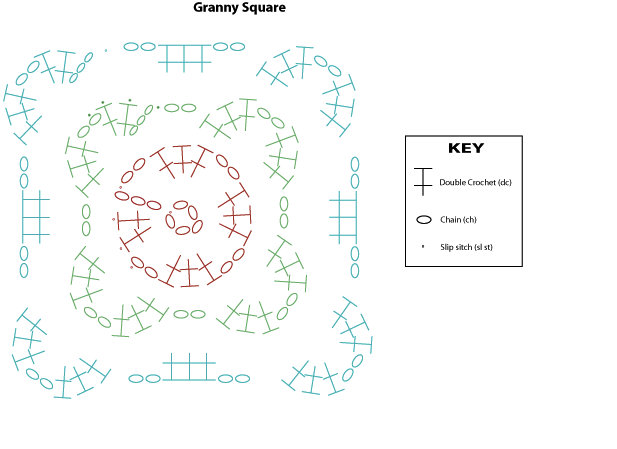
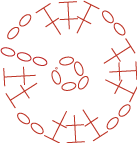
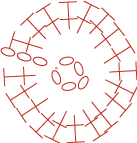
You can design your own granny squares! You just need to be consistent. Just like when you’re working a hat in the round, making a granny square involves using a consistent number of increases. In a traditional granny square, like the one in the chart below, there are 20 new stitches per round.

Granny Square Chart

So, if you wanted to play around with the look of the square–you could alter the arrangement of the stitches and chain spaces as long as you kept the number of stitches and the rate of increase consistent.

A first round like this one:

Tradititional Granny Square Round One

Establishes the corners right away, but one like this:

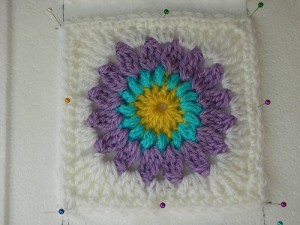
Would work just as well. Sort of like this one:

Photo By Flickr User Annua22a, CC-licensed, Some Rights Reserved

The way they get to square is by concentrating the increases in the corners in the final few rounds.

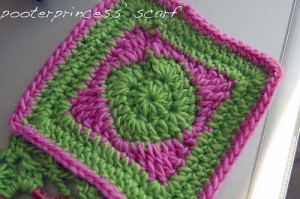
I love how this one by KnittyCent turns the square on its side, then back again.

Photo by flickr user KnittyCent, cc-licensed, Some Rights Reserved

Julie is working on a great post about planning the arrangement of your squares in a project. Stay tuned to the Skamama blog to see it.

Helping Haiti

Support Doctors Without Borders in Haiti

James told me today that the Coast Guard Cutter Oak (out of Charleston, NC) is on its way to help with the Haiti earthquake response. I’ve been meaning to make an additional donation to Medecins Sans Frontiers (Doctors Without Borders) since I heard about the disaster, but this news made me sit down and actually do it.

Have you heard of other ways to help? Please let me know in the comments.

Thanks.

We Have a Winner

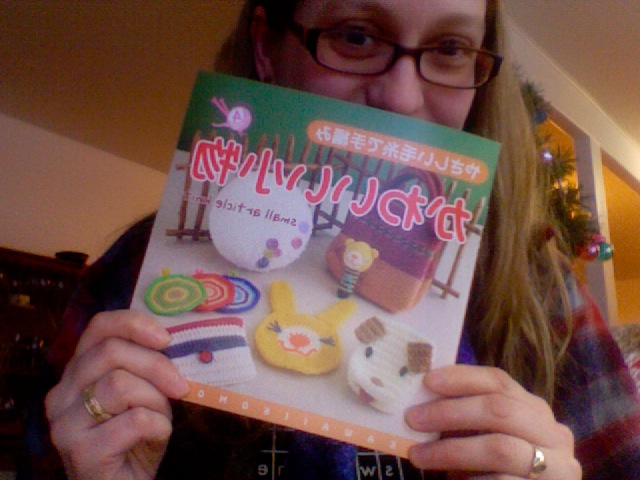
Congratulations to Caitlin of Running With Needles. She’s the winner of our little Japanese crochet book. I’ve been spending the last week working on a writing project that has kept me away from blogging. Hopefully I can talk more about it soon.

Today over at Crafty Pod, Sister Diane has a great post on her blog about Japanese craft books, and there’s a good discussion going in the comments, too. I agree with her–US craft books need to take a look at what works in the Japanese model and adopt more of it into our own publications.